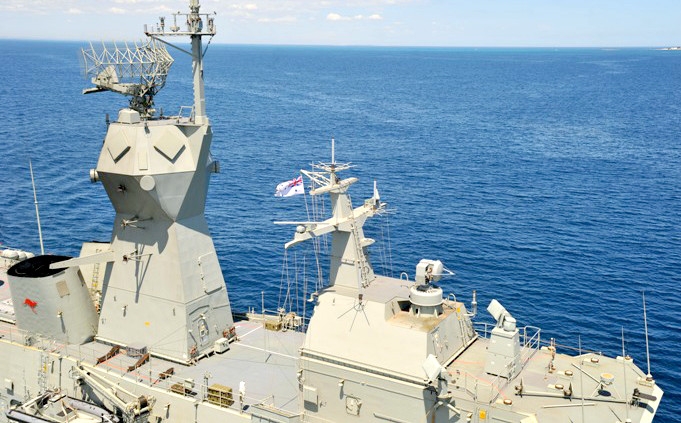
NEWTOWN, Conn. -- Australia funded the CEAFAR radar in part as an initiative to bolster the domestic defense industry and develop more high-level indigenous systems. To win the initial competition, CEA Technologies designed a modular, active electronic phased array system, scalable for a wide variety of roles.
As a result of its scalability, the CEAFAR technology is versatile, and, although CEAFAR's primary mission application to date has been as a naval radar, the system can also be utilized in land-based settings. For land-based use, the CEAFAR is mounted on a truck platform or installed as part of a tower-based setup. In all settings, the radar can be set up with varying mission performance characteristics.
Production in support of the Anti-Ship Missile Defence (ASMD) upgrade of Australia's ANZAC frigate, after being slightly delayed in 2017, will finish this year. Eight ships are receiving the CEAFAR upgrade.
On the horizon is Australia's SEA 5000 Future Frigate program, which seeks to develop a successor to the ANZAC alongside the creation of a next-generation CEAFAR radar. To satisfy this requirement, Australia has contracted CEA Technologies to develop a next-generation, high-powered CEAFAR variant known as the CEAFAR2.
Full CEAFAR2 production deliveries in support of the SEA 5000 future frigate are not expected until 2026 at the earliest. Delivery of an Air Search Radar, known as the CEAFAR2-L - a component of the eventual full CEAFAR2 ecosystem - is expected to begin in 2020, and will support ANZAC retrofits.
Outside the Australian home market, it is foreseeable that CEA might gain contracts for the ship-based CEAFAR. Neighboring coastal countries would be the primary buyers in this scenario, as they move to enhance their regional ties with Australia. An additional source of orders could be other Anglophone allies. Indeed, a CEAFAR-equipped vessel is part of Navantia's bid for a Canadian requirement and Former Australian Minister for Defense Industry Christopher Pyne has discussed the CEAFAR as a possible solution with U.K. counterparts.
Another frontier for the CEAFAR, the land-based-market has the potential to prove lucrative. CEA Technologies already has a near lock on Australia's Short Range Ground Based Air Defence (SRGBAD) requirement, part of the country's LAND 19 Phase 7B program. An early prototype for SRGBAD was configured with the CEAFAR-derived CEATAC equipping a Thales Australia Hawkei vehicle.
CEA Technologies is also reportedly modernizing its earlier CEAFAR GBMMR concept, creating a package utilizing the company's most up-to-date technologies. The resulting system, the CEAOPS will be part of a longer-range GBAD solution that, if purchased, would still be organized under the LAND 19 Phase 7B program.
A report on the CEAFAR program and other related systems are part of Forecast International's Land & Sea Based Electronics Forecast and Radar Systems Forecast products. For an up-to-the-hour updated view of these markets, including dynamic charts and an increased ability to interact with market forecast data, Forecast International provides can provide clients with the Platinum Forecast System. To learn more about these products, please contact your Forecast International sales representative.