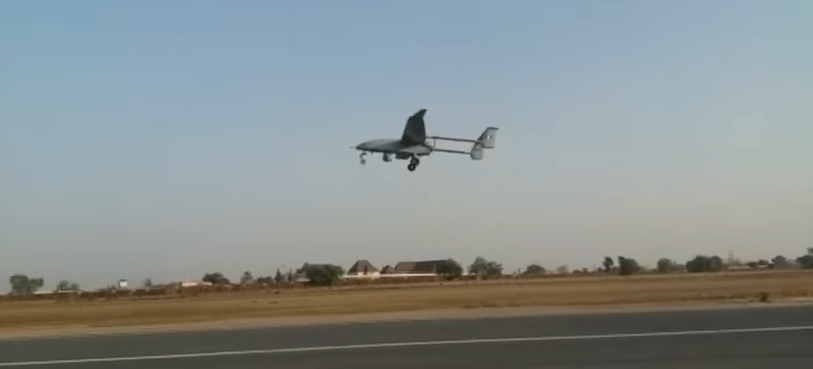
ABUJA -- The Nigerian Air Force (NAF) inducted the first indigenous operational Unmanned Aerial Vehicle (UAV) nicknamed, Tsaigumi, on Feb. 15. The Tsaigumi UAV, which was produced by NAF Aerospace Engineers in collaboration with UAVision of Portugal, can be used for intelligence surveillance and Reconnaissance (ISR) operations in land and sea domains. Other applications include policing operations, disaster management, convoy protection, maritime patrol, pipeline and power line monitoring as well as mapping and border patrol duties. In addition, it can be deployed for the protection of wildlife, weather forecast and telecast. Additionally, in the maritime domain, the Tsaigumi UAV can be used for search and rescue, coastal monitoring and patrol of Nigeria’s Exclusive Economic Zone.
While the Gulma UAV is the NAF’s first indigenous UAV, the newly inducted Tsaigumi is the first indigenous operational UAV. Both UAV types are the outcomes of R&D efforts of a team of NAF Aerospace Engineers. NAF’s foray into UAV development began in 2008, when its student officers, who were undergoing postgraduate studies in aerospace engineering programs at Cranfield University, UK, chose UAV development as their research project. The student officers produced the AMEBO UAV as part of their project and it had neither autopilot nor ISR capability.
By 2013, the NAF developed an experimental UAV, codenamed Gulma, which was then unveiled as the first indigenous UAV. It is noteworthy that Gulma UAV was a technology demonstrator used to gather performance data on UAV systems. Consequently, in September 2015, the Chief of the Air Staff (CAS), Air Marshal Sadique Abubakar, directed the NAF’s R&D Team to build an operational UAV, codenamed Tsaigumi to be used in the Northeast and other theaters of operation in Nigeria. The data gathered from the Gulma prototype was subsequently applied in the Tsaigumi's design. Although the Tsaigumi UAV was manufactured at the Air Force Research and Development Centre at NAF Base Kaduna, the Team had to collaborate with an overseas facility to produce the molds.
The Tsaigumi UAV, which is capable of day and night operations, has an operational endurance in excess of 10 hours, a service ceiling of 15,000 feet and a mission radius of 100km. It has a maximum take-off weight of 80kg and its payload comprises an electro-optical infrared camera system as well as weapon hard points. The Tsaigumi UAV, whose engine sound is muffled, has a state of the art encrypted communication system. It has a wingspan of 5.5metres and is able to gather real time weather information.
For its part, the Gulma UAV has an operational endurance of 4 hours, a service ceiling of 5,000 feet and could not be operated beyond 20km. It has a maximum take-off weight of 40kg and its payload offers only an electro-optical camera system. The Gulma UAV, whose engine sound is not muffled, relies on direct radio frequency communication system with attendant limitations.
The NAF is currently working on the Ichoku, which when completed, would be the first indigenous unmanned combat aerial vehicle (UCAV).