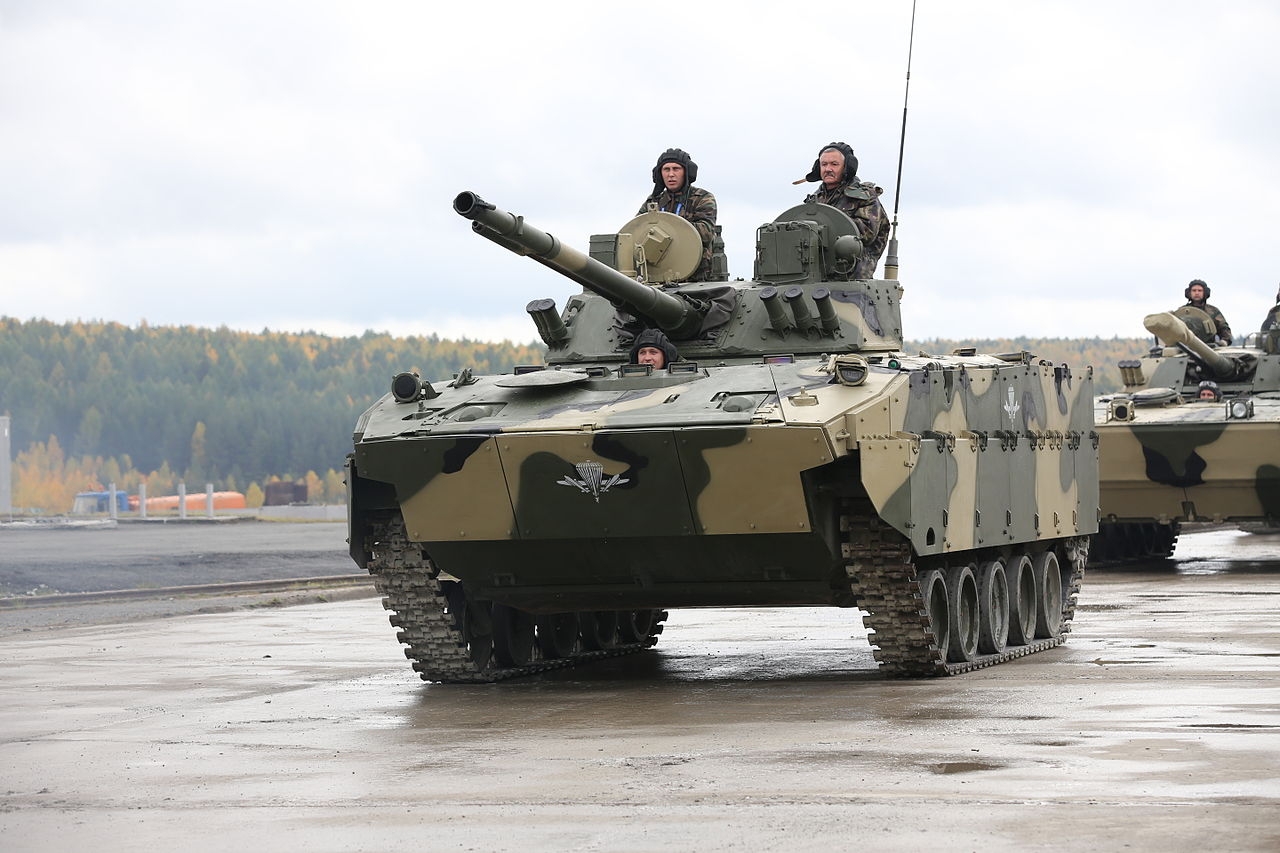
NEWTOWN, Conn. - The Russian Military considers the BMD-4 series a critical asset for the implementation of airborne (Vozdushno-Desantnye Voyska, or VDV) and Naval Infantry operations.
Although the condition of the Russian economy and defense-industrial base will serve to limit the scale of BMD-4 procurement during the forecast period, the program nevertheless remains an important component of the Military's modernization initiative.
The initial BMD-3 series vehicles delivered to the VDV have now been in active service for over 20 years. As a result, we anticipate that the service will initiate a fairly comprehensive retrofit program for its active BMD-3 stocks during the forecast period to a performance standard analogous to that of the BMD-4M.
New-build production of the base-model BMD-3 and BMD-4 vehicles is dormant, superseded by the BMD-4M.
The significantly modernized BMD-4M design represents the future of the BMD series in Russian Military service.
The Russian Ministry of Defense placed an initial order for 20 pre-series production BMD-4M vehicles in 2012, allocating 10 units each to the VDV and Naval Infantry for use in performance testing and operational trials. The prime contractor began shipment of these preliminary testing models in mid-2013 and completed deliveries during the first half of 2014.
Later that same year, the MoD and VDV concluded the vetting process for the BMD-4M and proceeded to approve the design for serial-production and procurement shortly thereafter.
Although some reports indicated that the Russian MoD had envisioned the BMD-4M entering series-production in 2016, the expedited length of the testing process allowed for a corresponding acceleration of the overall project timeline.
The VDV inducted the first 12 serial-production BMD-4M units into active service in March 2015. According to statements made by VDV officers to the Russian press, the service hopes to acquire an approximate total of 64 BMD-4M vehicles through 2015.
Although maritime trials of the BMD-4M were undertaken concurrently with those of the airborne arm, the niche capabilities required of the Naval Infantry's planned variant necessitate a later deployment date.
Russia's 2011-2020 State Armaments Plan envisioned an intensely demanding production timeline for the BMD-4M, involving the procurement of up to 1,000 new-build units during the indicated timeframe and subsequent reports have outlined the acquisition of an additional 500 units during the period 2020-2025.
The practical limitations of Russia's defense-industrial base would have made this acquisition plan exceedingly ambitious even during prosperous economic times, and with the nation's economy now straining under the dual impediments of low oil and gas prices and targeted Western sanctions, this rate of production is not likely to be feasible.
The Russian MoD has traditionally considered the VDV to be one of the primary spearheads of Russia's offensive military capability, and as such the service has long enjoyed preferential treatment in regard to the procurement of advanced new vehicles and equipment.
As such, the VDV have often been at the forefront of Russia's ambitious military modernization program, a fact most recently testified to by the deployment of noticeably well-equipped and highly professional VDV troops in the precarious early stages of Russia's annexation of the Crimean peninsula.
The Russian Army currently maintains four airborne divisions and several independent brigades in active service, and recent reports indicate that the Army hopes to raise an additional three airborne brigades during the next decade.
However, although these units may stand as some of the best-equipped and most combat capable in the Russian military's force structure, fiscal and practical constraints nevertheless continue to inhibit the pace and scale of the VDV's vehicle replacement program.
The low-rate historical of BMD-3 and BMD-4 since 1990 has only allowed the service to fulfill a scant 25 percent of the airborne service's total BMD requirement.
The Russian MoD and Government have sought to rectify some of these shortfalls through recent defense budget increases and the initiation of its modernization program. Nevertheless, we do not anticipate that the scale of BMD-4M production will prove sufficient to entirely replace the VDV's active stocks of aging BMD-1 and BMD-2 vehicles within the forecast period, or even for some period afterward.
Although the unique airborne capabilities of the BMD-4/4M could attract interest on the international market, the niche operational role for which the vehicle is intended primarily serves to limit its overall export potential.
A relatively small quantity of export orders for the design are likely to materialize during the forecast period, such as the rumored Indonesian order for 54 BMD-4 vehicles, but the ambitious demands of Russian VDV and Naval Infantry procurement are likely persist in monopolizing the majority of the BMD-4/4M production through the 2024.